“the more i saw them, the more i hated lies.”
I know I’m not the only one who’s thought about this war/not war, reason/treason battle. The problem is, have any of you looked at the 3 sided coin of this 3-ring circus before you let the “experts” of the snooze media allowed you to decide? The people spewing their “news” and opinions don’t even write their own words; similar to the “share” button on Facebook.
Shampoo, rinse, repeat…
“They were conquerors, and for that you want only brute force—nothing to boast of.” – Joseph Conrad
I’m fed up and disgusted at the three-headed monster; both political parties and the corporate/Wall Street billionaires who offer their “lending hand” in good faith to the suckers we are liking their palms for scraps.
I thought I had a side, then I decided to look again, to question, to use that silly critical thinking thing in my bean. If you are still questioning, if you are still a hard line backer or retractor…enjoy. At the end, let me know your thoughts in the comments at the end…
UNDECLARED, UNDEFINED, UNFINISHED: WHAT DO WE CALL A WAR WE WON’T EVEN NAME:
America has a real talent for doing monstrous, historic, world‑shaking things while describing them like a scheduling conflict. We don’t go to war anymore. Oh no. That would require clarity. That would require Congress to do something other than pose for cameras and foam at the mouth on cue. That would require adults to walk to the podium and say, plainly, we are now at war, here is why, here is the cost, here is the objective, and here is what success looks like. Instead, we get the cheap‑cologne version. We get “operations.” We get “responses.” We get “deterrence.” We get “messages.” We get “limited actions.” We get “restoring stability” while the region catches fire, oil convulses, civilians die, and the public is expected to nod along like this is some kind of contained little policy adjustment instead of the kind of thing that can crack open history. Current reporting says the U.S.-Iran war is about five weeks old, ceasefire proposals are moving through mediators, Iran has rejected a temporary truce, and the Strait of Hormuz remains a central choke point in the crisis. So let’s stop kidding ourselves. If people are dying, if infrastructure is threatened, if global shipping lanes are being leveraged like a loaded gun, if oil prices are swinging because the world thinks this thing could get even uglier, then this isn’t some semantic exercise. This isn’t “heightened tension.” This isn’t a tough‑guy press release with missiles attached. This is war behavior, whether or not the people in charge have the backbone to use the word.
Oil and stock markets have already been whipsawing around this crisis, with reports tying the volatility directly to the Hormuz threat and threatened U.S. escalation. And that should bother everybody. Not just anti‑war people, not just hawks, not just independents like me who are sick of being told every disagreement has to be sorted into red team or blue team like politics is a goddamn pee‑wee football game for emotionally stunted adults. Everybody.
LET’S START WITH THE UNCOMFORTABLE PART: IRAN IS NOT SOME INNOCENT BYSTANDER:
Now before the usual mouth‑breathers start flinging labels around, let’s be clear; Iran is not a misunderstood choirboy getting picked on by the school bully. It has long been treated by the U.S. and regional powers as a serious security threat because of its nuclear posture, missiles, drones, proxies, and willingness to use the Strait of Hormuz as leverage. That is not fantasy. That is not cable‑news fan fiction. That is one of the central facts of the crisis, and it is being stated openly by regional governments involved in trying to shape the endgame. So yes, there is a case for force, a real one. People backing military pressure are not automatically idiots, monsters, or oil‑drunk lunatics pounding their desk to old war movies. Their argument is simple enough to understand; if Iran can threaten a global shipping artery, treat diplomacy like a delay tactic, and keep testing limits while everyone else issues strongly worded statements and holds another conference under fluorescent lights, then deterrence becomes a joke. And once deterrence becomes a joke, bigger wars get easier, not harder. That’s the strongest pro‑force argument and pretending otherwise is dishonest. But here’s the problem; a valid concern does not automatically justify a stupid method. That is where this whole thing starts smelling less like strategy and more like performance.
THE AMERICAN WAY: ALL THE FORCE, NONE OF THE CLARITY:
This is the scam. An undeclared war gives leaders the action‑hero optics of war without the burden of war’s full political honesty. That’s the whole rotten magic trick. You get to move pieces on the board. You get to sound decisive. You get to bark threats. You get to flood the airwaves with macho language about strength, consequences, resolve, hellfire, red lines, dominance, and all the rest of the testosterone‑scented perfume. But you don’t have to nail yourself to a precise objective with the kind of public specificity that citizens could actually measure later. That is not a minor flaw; that is the flaw. Congress has the constitutional power to declare war, and the War Powers Resolution says the president’s authority to introduce U.S. forces into hostilities is supposed to be tied to a declaration of war, specific statutory authorization, or a national emergency created by an attack on the United States, its territories, possessions, or armed forces. But look at how this country now operates.
We have somehow built a permanent twilight zone where something can be grave enough to kill, grave enough to spike markets, grave enough to drag the whole damned region toward catastrophe and still be talked about like it’s a highly energetic policy memo. That should insult your intelligence. Because if this is serious enough to fight, it is serious enough to define. If this is necessary, then tell the public the objective. If this is justified, tell the public the legal basis. If this is strategic, tell the public what winning looks like and if you can’t do those things cleanly, maybe the problem is not that the public is too dumb to understand. Maybe the problem is that the people running this either don’t know where it ends or don’t want to be pinned down when it doesn’t.
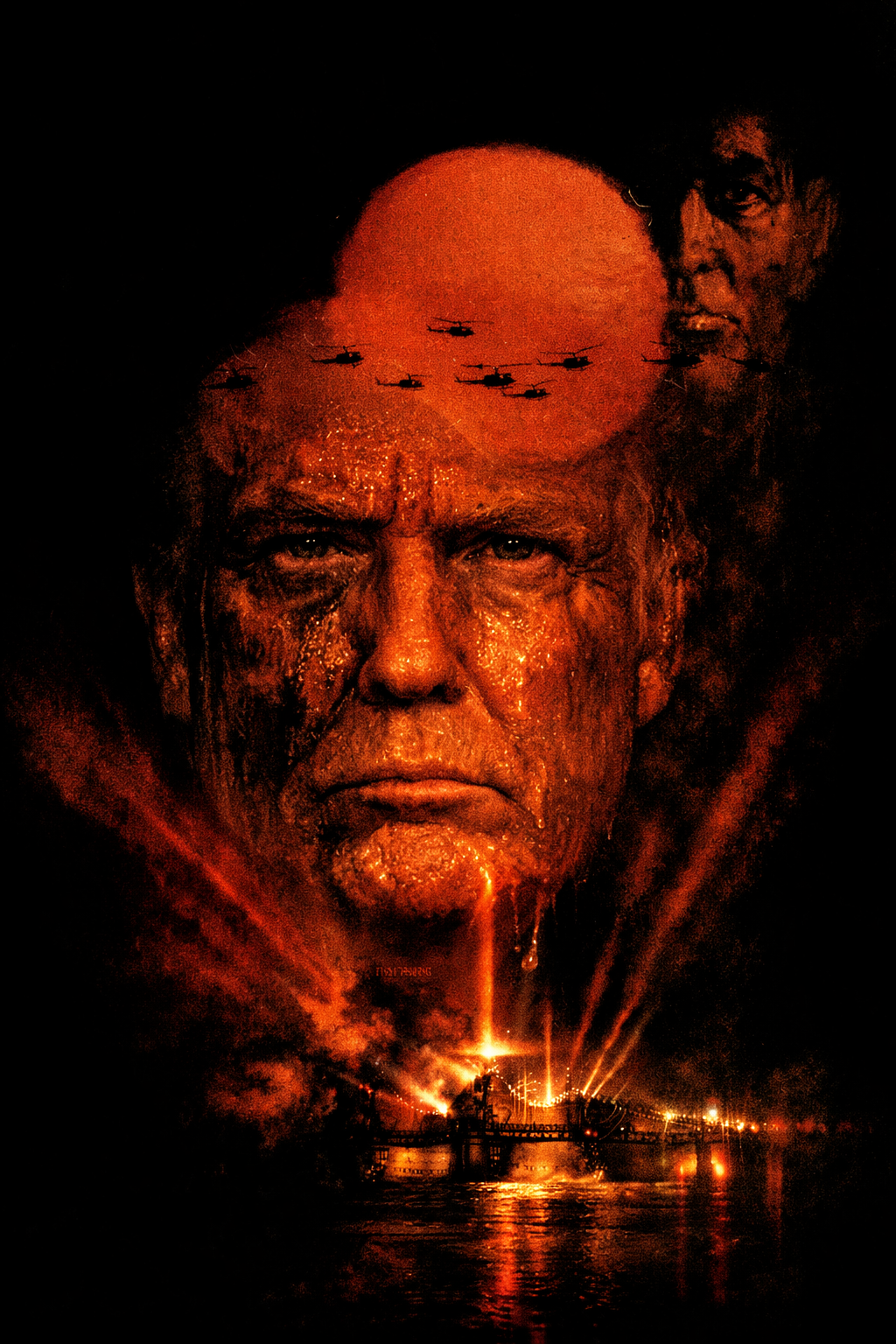
THIS IS WHERE THE “HEARTS OF DARKENSS” BRAIN ROT SETS IN:
And this is the part that should make every reader stop and ask whether they’re witnessing statecraft or cosplay. Because once foreign policy starts sounding like a drunken blend of frontier mythology, cable‑news bravado, and social‑media deadline theater, you are no longer watching a nation being led. You are watching a nation being performed. Reuters and AP both reported on April 6 that Trump tied the crisis to a deadline for reopening the Strait of Hormuz and threatened severe action against Iranian infrastructure if that did not happen. Now forget who you voted for. Forget what bumper sticker you hate. Forget whether your personal brain worms only activate when the “other side” does this. Ask the actual question, “Is that practical or is that theater dressed as strength”. Because the two are not the same.
Theater loves deadlines, theater loves ultimatums, theater loves chest‑thumping. What theater also loves is simple language for complicated disasters. Theater loves making every hard problem sound like it can be solved by one more show of will. Real strategy is uglier than that; real strategy worries about the next ten moves, not the next applause break. Real strategy worries about second‑order effects. Real strategy worries about what happens after the speech, after the strike, after the markets jump, after the enemy adapts, after civilians are trapped under the consequences of somebody else’s “toughness.” And if yourversion of leadership looks more like a Colonel Kurtz fever dream than a disciplined plan with a clear exit ramp, then maybe what people are calling strength is really just swagger with a body count.
WHAT IF THIS IS LEGAL ENOUGH TO DO, BUT NOT WISE ENOUGH TO CONTINUE:
There is another layer here that should make readers uneasy no matter what side they start on. A thing can be legally arguable and still strategically disastrous. A president may claim authority under commander‑in‑chief powers or under circumstances involving hostilities and emergency conditions. That does not magically answer whether a course of action is sustainable, accountable, or wise. And when legal experts start publicly warning about war‑crimes exposure for attacks on civilian infrastructure, that should not be waved away as activist squealing or partisan lawfare. Reuters reported on April 2 that more than 100 international law experts signed an open letter saying some recent American strikes on Iran may amount to war crimes. Maybe those experts are right in full, maybe they’re overstating it. Maybe the facts will evolve, but this much is already true: once civilian infrastructure becomes part of the public threat matrix, the moral and strategic terrain gets far messier. And that is where every casual keyboard general ought to slow down. Because it is easy to say, “Do what it takes,” when “what it takes” is still a slogan. It gets harder when “what it takes” may include destroyed power systems, civilian suffering, wider regional retaliation, harder diplomacy, and a precedent America itself may hate the next time somebody else invokes it.
THE LEGALITY QUESTION IS NOT A SIDE SHOW
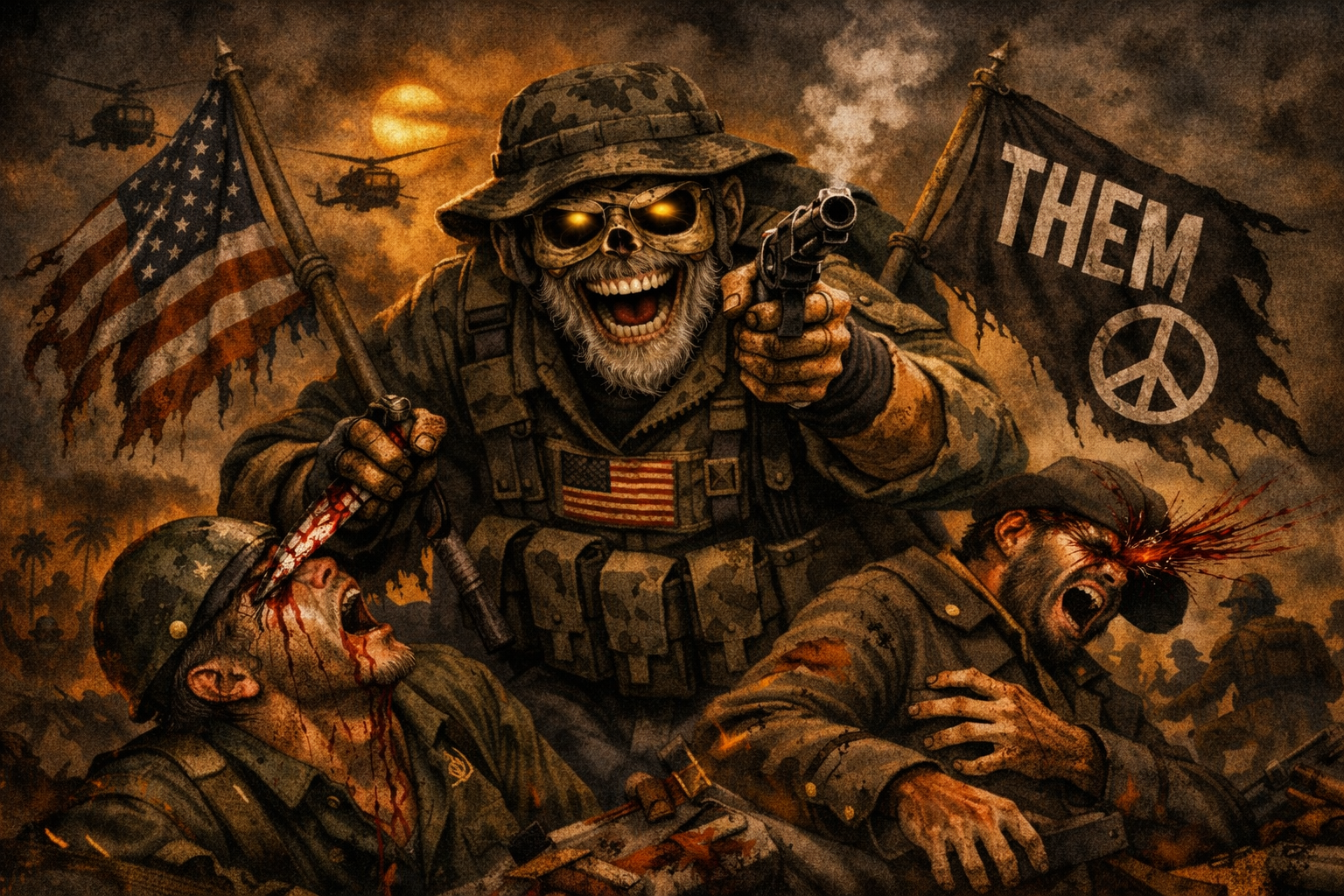
Here is another thing Americans love doing; treating legality like an annoying little technicality that lawyer’s fuss over while the “real men” handle the serious business. That attitude is how republics rot. When legal experts start warning that certain strikes may amount to war crimes, that is not a detail you brush aside because it ruins the macho vibe. Reuters reported on April 2 that more than 100 international law experts signed an open letter saying some American strikes on Iran may amount to war crimes. Maybe they’re completely right or maybe they’re partly right. Maybe the facts will evolve. But civilized nations are supposed to care about that question before everything is reduced to ash and hindsight. Once you start publicly threatening civilian
infrastructure, you are no longer operating in some clean moral action film where only “bad guys” feel the consequences. You are moving into the filthier territory where every claim of necessity drags behind it a chain of human, legal, and strategic consequences that do not disappear just because the press conference was forceful. And that matters. It matters because every precedent you normalize abroad eventually comes limping back home in one form or another: politically, morally, institutionally, rhetorically. Empires always think they are writing exceptions. Usually, they are writing habits.
THE ANTI‑WAR POSITION HAS ITS OWN HARD QUESTIONS TO ANSWER
Now, for fairness, the anti‑war crowd does not get a free ride either. It is easy to oppose escalation in theory. It is harder to explain, concretely, what replaces it. If not force, then what exactly compels Iran? What creates leverage? What secures the Strait? What reassures allies? What stops future brinkmanship from becoming normal operating procedure? “Diplomacy” is not a plan unless it comes with terms, enforcement, incentives, and consequences. “No more war” may be morally attractive, but policy still has to answer what fills the vacuum when coercion is taken off the table. And that is where some anti‑war rhetoric collapses into sentimentality. It sometimes speaks as if every use of force is equally foolish, every adversary is equally reachable, and every crisis can be solved if only more reasonable people sit at a table longer. History is not that kind. The world is not that kind. Adversaries are not that kind. So, the real question is not whether one side loves peace or the other side loves war; that framing is childish. The real question is whether the United States is currently applying force in a way that is tied to a precise objective, a credible off‑ramp, and a publicly defensible standard of success. If the answer is no, then supporters of escalation have work to do. If the answer is yes, then critics of escalation have work to do.
THE PUBLIC IS BEING ASKED TO ABSORB A LOT WITHOUT A CLEAR VOTE:
This may be the most unsettling part of all. Formal declarations of war are rare in modern American life, but the absence of a declaration does not mean the absence of consequence. It simply means the consequence gets socially distributed in a different way. The troops bear it, the region bears it, civilians bear it. Markets bear it, families bear it and voters are often left trying to piece together what has already been decided for them. That is one of the hidden corruptions of undeclared war; it lowers the political cost of entering conflict while preserving nearly all of the human cost of fighting one. Which raises a question every reader should sit with; if the situation is grave enough to justify hostilities, why is it not grave enough to demand full public clarity? Why are Americans so often expected to live inside the consequences of war while being spoken to in the euphemisms of “operations,” “responses,” and “measured actions”? Why does the language get smaller while the stakes get bigger? Maybe because smaller language keeps the public calmer. Maybe because ambiguity preserves flexibility. Maybe because nobody wants to own the full word… w-a-r!
THE HAWKS HAVE QUESTIONS TO ANSWER:
Now let’s be fair and spread the discomfort around. If you support what’s happening, then answer like an adult. What is the objective? Not your emotional objective, not your revenge fantasy, not your “they need to learn a lesson” chest‑beating. The actual objective. Is it reopening Hormuz? Is it crippling Iran’s military capacity? Is it forcing a diplomatic settlement? Is it restoring deterrence? Is it regime destabilization? Is it all of the above? Because if the answer is “all of the above,” that usually means nobody has the discipline to prioritize and when nobody prioritizes, wars metastasize.
Also, tell me what success looks like. Don’t give me a movie ending. Give me a real one. What would have to happen for you to say, “Yes, this was worth the risk, the cost, the market shock, the civilian danger, and the possibility of widening the war”? If you can’tanswer that, then maybe you don’t support a strategy. Maybe you just support motion. And motion is catnip in this country. Americans love action because action creates the illusion of control, even when all it really does is widen the blast radius.
THE DOVES HAVE QUESTIONS TO ANSWER TOO:
Now for the anti‑war crowd, because they do not get to float out of this one on a cloud of moral perfume either. If not this; then what? No, really. What? If force is off the table, what compels Iran? What secures shipping? What reassures allies? What prevents the next round of coercion? What creates leverage strong enough to matter? Because “diplomacy” is not a magic word. It is not holy water, it is not a protection spell you say three times while clicking your heels and hoping bad actors suddenly become cooperative, transparent, peace‑loving participants in the rules‑based international order. Diplomacy without leverage is begging in a necktie. So if you oppose escalation, fine. That may even be the wiser position. But wisdom still has to explain itself. It still has to tell people what replaces force, what risks are being accepted instead, and why those risks are preferable. Otherwise, anti‑war rhetoric becomes every bit as lazy as war rhetoric, just with better manners and fewer flags in the background.
THE COST IS NOT ABSTRACT, AND THE BILL ALWAYS FINDS REGULAR PEOPLE
Another lie America tells itself is that war lives “over there.” No,it doesn’t. It comes home in prices. It comes home in stress. It comes home in uncertainty. It comes home in supply shocks, inflation pressure, and the quiet daily erosion of stability for people who will never sit in the room where these decisions are made. AP and Reuters both reported on April 6 that the Hormuz crisis and threatened escalation have been jolting oil markets and pushing buyers toward expensive alternatives. So let’s not do the usual fake patriotic nonsense where the only “cost” people talk about is whether somebody on television looks weak. Weak? Try explaining “strength” to a family paying more for everything because global energy markets are being used like a pressure point in a geopolitical bar fight. Try explaining “resolve” to civilians in the blast zone. Try explaining “credibility” to the people who are always told sacrifice is noble right up until the bill lands in their mailbox, their neighborhood, or their cemetery. That doesn’t automatically mean the war is unjustified. It means anyone calling it justified should have the decency to count honestly.
WHAT DOES “WINNING” EVEN LOOK LIKE HERE:
This is where the conversation gets brutally honest. How does this end? With Iran backing down? With a deal? With a reopened Strait? With regime humiliation? With deterrence restored? With a frozen standoff? With more regional fires? With American forces pulled deeper in because initial pressure failed to achieve all the goals politicians hinted at but never clearly named? Reuters reported that ceasefire frameworks are being shuttled through intermediaries and that Iran has sent back a counterproposal rather than accept a temporary truce. That alone tells you something important; this is not a clean one‑act drama. It is bargaining through escalation, diplomacy under duress, and pressure without certainty. Which means we should stop pretending that every display of force automatically produces clarity. Sometimes it produces leverage. Sometimes it produces backlash. Sometimes it produces both at once. Sometimes it produces a temporary advantage that carries a larger strategic bill later. And maybe that is the most adult way to look at all of this; not as a morality play with saints and villains, but as a dangerous exercise in tradeoffs.
SO WHAT THE HELL IS THIS, THEN:
That is the question that keeps chewing at me. What do you call a war nobody wants to define? What do you call a conflict serious enough to kill, destabilize, coerce, and reorder markets, but still wrapped in language designed to dodge full democratic accountability? What do you call a government posture that says, in effect, “Trust us, this is necessary,” while refusing to provide the kind of clarity that necessity ought to demand? Maybe you call it modern American warfare. Maybe you call it executive convenience. Maybe you call it strategic ambiguity. Maybe you call it politics doing what politics does best, shrinking language so the public doesn’t fully absorb the size of the thing being done in its name. Whatever you call it, don’t call it clean. And for the love of God, don’t call it simple because it isn’t. There are serious reasons to fear Iran. There are serious reasons to distrust theatrical escalation. There are serious reasons to believe that force sometimes works. There are serious reasons to believe undeclared war corrodes public accountability and invites mission creep. All of those things can be true at once, and that is precisely why the usual tribal scripts are so pathetic here. If you are reflexively cheering, slow down. If you are reflexively condemning, sharpen up. If you are using party loyalty as a substitute for thought, stop embarrassing yourself. If you think this is just another round of “our side strong, their side weak,” then you are not analyzing a conflict. You are consuming propaganda with your preferred seasoning.
HERE’S THE QUESTION I’D PUT TO EVERY READER
Before you take a side, answer this…If this is not really war, then what level of death, destruction, market panic, regional danger and constitutional sidestepping does it take before you’re willing to call it one?
Current reporting describes sustained hostilities, civilian casualties, direct threats against infrastructure, and active ceasefire efforts involving multiple mediators. And if it is war, then why are we still tolerating the toddler‑level political trick where grown men play with war powers while dodging the full burden of naming the thing honestly? That is the question.
Not “Are you patriotic?” Not “Do you support the troops?” Not “Whose side are you on?” Not “Are you strong enough to do what must be done?”
No, but, Are you willing to demand clarity equal to the consequences?
Because if the answer is no, then don’t flatter yourself that you’re defending democracy, peace, strength, order, or justice. You’re just giving powerful people extra room to improvise with other people’s blood. And America has been doing that for a very long time. Long enough, maybe, that we don’t even notice the smell anymore.
Well? The ball is in your mine field now, thoughts?
