Interlude I — Bridge to the 80s
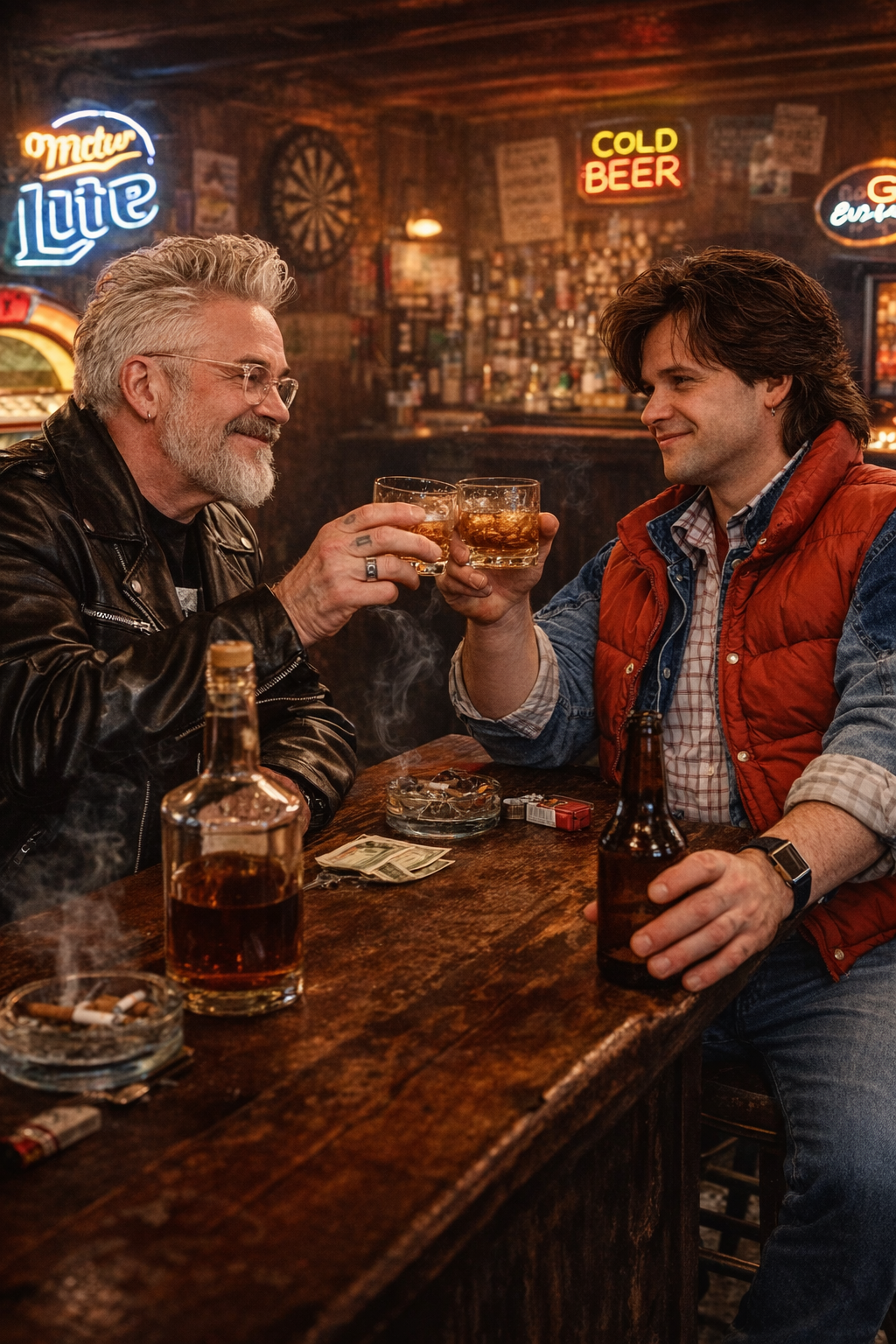
“Well, the music there, well, it was hauntingly familiar”
to the future past
Have you ever seen an episode of MTV’s old reality show, The Real World? It always started with an intro of what happens when you put strangers in a place where they’re stuck with each other, mine would be…
“This is the true story... of one stranger with seven personalities... picked to live in a house with himself and have their lives taped... to find out what happens... when people stop being polite... and start getting real...”
Well,it’s time to get real.
The 70s gave me reckless abandon, but the 80s made me pay the bill. The swagger I carried into that decade wasn’t confidence—it was camouflage. I didn’t know that then. I thought I was bulletproof, thought the world was a stage, thought the applause was real. Puberty hit like Bonham slamming a crash, and I mistook the noise for identity. Then the 80s arrived and made it clear: the noise wasn’t me. It was everything I used to drown myself out.
Crossing into adulthood wasn’t a rite of passage; it was a collision. I spent most of the decade in that no‑man’s‑land between who I pretended to be and who I actually was. I kept one foot in childhood because I didn’t trust myself with both feet in adulthood. At 64, I still keep a timeshare there. That’s not shame; that’s honesty. Men don’t “grow up”; we just get better at hiding the parts that never did.
Graduation, college, marriage, fatherhood, they didn’t unfold; they ambushed me. I didn’t step into those roles; I stumbled into them, performing the version of a man I thought I was supposed to be. I had just enough piss and vinegar to bluff my way through, and just enough fear to never admit I was bluffing. Performance wasn’t a choice; it was survival. And the 80s rewarded performance more than truth.
I became a composite character: part Peter Pan, part poser, part competitor, part actor. The real me, the quiet, scared, unpolished version was shoved backstage. I wasn’t living; I was improvising. There was no more of me trying to go unnoticed, but that spotlight and applause I chased was just another drug.
I’m not proud of that. I let the villain in my own head run the show. Ego was the script. Vanity was the costume. Instant gratification was the director. Self‑loathing handled lighting and sound. I was a man‑child with a spotlight and no script, convinced the spotlight meant something.
The decade didn’t help. The 80s were engineered to amplify every bad instinct. Too much was never enough. The Me Generation didn’t ask for accountability; it asked for results. Success wasn’t measured in character, it was measured in noise, speed, shine, and how convincingly you could pretend you were thriving. I didn’t stand out as an asshole because the whole decade was a parade of assholes. I just blended in.
And now? Every scar on my soul is a rerun I can’t turn off. I see the self‑inflicted wounds. I see the collateral damage. I see the people I hurt because I didn’t know how to value myself, let alone anyone else. I’ve forgiven myself, but I haven’t forgotten. Forgetting would be the real sin. Remembering is the only thing that’s kept me grounded for twenty‑five years. It’s the guardrail that keeps me from drifting back into the performance.
But the 80s from where I stood?
The 80s weren’t a decade; they were a technicolor relapse into adolescence. Everything felt louder, faster, and chemically enhanced. Music didn’t evolve—it detonated. Synths broke off from their krautrock parents, strapped on steel-toed boots, and marched straight into the industrial age. Arena rock split like a fault line: one branch sharpened into speed‑leaning metal, another teased its hair to the heavens and got labeled “hair metal,” and the Bay Area and East Coast were quietly forging the next generation of heavy metal in garages that smelled like sweat, cigarettes, and ambition. Even the alternative strain from the 70s was mutating into the emotional rawness that would later be called emo.
Every lane had one thing in common: the music was built to hit you in the chest. There was always something to blast at any party, and nobody cared about genre purity. Pop supercharged R&B and turned dance floors into neon laboratories. Rap took the storytelling bones of folk music, added drum machines and street reportage, and became the new national broadcast signal.
And the culture? It was running on the same voltage. Cocaine wasn’t a velvet‑rope accessory anymore—it was everywhere, the unofficial sponsor of the decade. Then came its volatile offspring, crack, and suddenly the party had a body count. MTV didn’t invent excess, but it sure gave it a 24‑hour broadcast window. The decade’s thesis was simple: Too much is never enough. What used to be weekend mischief in the 70s became a second job in the 80s. This was the era that didn’t just flirt with decadence—it married it, moved in, and maxed out its credit cards.
The free‑love looseness of the 60s and the anything‑goes experimentation of the 70s were warm‑ups. The 80s were the main event. It was the cultural prequel to The Decline of Western Civilization Part II—a world where temptation wasn’t hidden; it was stacked on the buffet table, and the only rule was to keep the night going. If you were young, curious, and breathing, the decade practically dared you to jump in. Being someone that didn’t love a good dare, I dropped my pants and dove right the fuck in.
The music for each year didn’t matter, there was something for anything and everything going on. By the end of the decade though, it became a musical hangover. Maybe we found out how too much might actually have been too fucking much.
